Bounding the approximate interventionist direct effect using causal mediation analysis
In my previous post I discussed a scenario where the interventionist approach to mediation analysis may fail if the treatment cannot be separated into different components. Below is a more positive story, discovered with the help of an LLM, that shows the usual direct effect estimand generally lowers bound an “approximate interventionist direct effect” in this case.
We are evaluating a mediation scenario where the \(A \rightarrow Y\) directed edge is fully mediated by an unobserved variable \(A_Y^{*}\). Consider the following causal diagram:
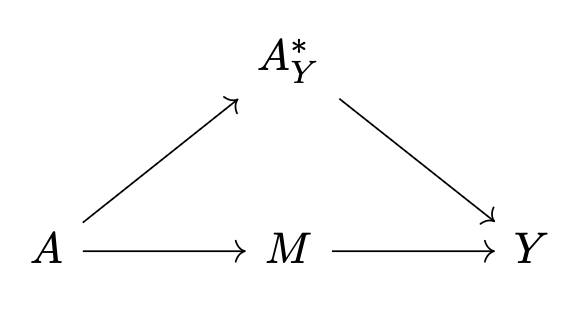
This structure implies two critical conditional independencies:
- \(A_Y^* \perp M \mid A\).
- \(Y \perp A \mid A_Y^*, M\)
We are interested in estimating the direct effect of \(A_Y^{*}\) on \(Y\) defined as \[ \text{DE} = \mathsf{E}[ Y(A = 0, A_Y^{*} = 1) - Y(A = 0, A_Y^{*} = 0) ]. \] Conceptually, this can be viewed as an approximation to the direct effect of \(A\) on \(Y\).
By the standard g-formula and applying the conditional independencies above, we have
\begin{align*} \mathsf{E}[ Y(A=a, A_Y^*=a_y^*) ] &= \sum_m \mathsf{E}[Y \mid A_Y^*=a_y^*, M=m, A=a] P(M=m \mid A_Y^*=a_y^*, A=a) \\ &= \sum_m \mathsf{E}[Y \mid A_Y^*=a_y^*, M=m] P(M=m \mid A=a) \end{align*}
So we have \[\text{DE} = \sum_m \Big( \mathsf{E}[Y \mid A_Y^*=1, M=m] - \mathsf{E}[Y \mid A_Y^*=0, M=m] \Big) P(M=m \mid A=0).\]
Next, we relate the unobserved expectation \(\mathsf{E}[Y \mid A_Y^*=a_y^*, M=m]\) to the observed data \(\mathsf{E}[Y \mid A=a, M=m]\).Using the Law of Total Probability over the unobserved \(A_Y^*\):
Using the Law of Total Probability over the unobserved \(A_Y^*\):
\begin{align*} \mathsf{E}[Y \mid A=a, M=m] &= \sum_{a_y^*} \mathsf{E}[Y \mid A=a, M=m, A_Y^*=a_y^*] P(A_Y^*=a_y^* \mid A=a, M=m) \\ &= \sum_{a_y^*} \mathsf{E}[Y \mid A_Y^*=a_y^*, M=m] P(A_Y^*=a_y^* \mid A=a). \end{align*}
So
\begin{align*} &\mathsf{E}[Y \mid A=1, M=m] - \mathsf{E}[Y \mid A=0, M=m] \\ =& \{\mathsf{E}[Y \mid A_Y^*=1, M=m] - \mathsf{E}[Y \mid A_Y^*=0, M=m]\} \{P(A_Y^*=1 \mid A=1) - P(A_Y^*=1 \mid A=0)\}. \end{align*}
This shows that \[ \text{DE} = \frac{\sum_m \Big( \mathsf{E}[Y \mid A=1, M=m] - \mathsf{E}[Y \mid A=0, M=m] \Big) P(M=m \mid A=0)}{P(A_Y^*=1 \mid A=1) - P(A_Y^*=1 \mid A=0)}. \] So the absolute value of the directed effect of \(A_Y^{*}\) is also bounded below by the absolute value of the usual estimand for natural direct effect:
\begin{equation*} |\text{DE}| \geq |\text{Usual estimand for natural direct effect}|. \end{equation*}