Lecture 5: Path Analysis

Causal Inference and Statistical Designs · Michaelmas 2026 · Qingyuan Zhao

Spearman (1904) “General Intelligence”

Correlations between school-study rankings · 22 music pupils at a preparatory school.

Classics French English Mathematics
Classics — 0.83 0.78 0.70
French — 0.67 0.67
English — 0.64
Mathematics —

One common factor? Shared variation implies vanishing tetrads in the population (here 0.78 × 0.67 − 0.70 × 0.67 = 0.054 in the sample).

Spearman (1904), “General Intelligence,” Objectively Determined and Measured, p. 275. Selected off-diagonal entries; original text and table.

Black et al.: Ethical intentions

Explaining ethical intentions: how people justify misconduct, and how ethics training relates to their choices.

270 accounting professionals first answered

  • 8 questions about moral disengagement;
  • 15 questions about four hypothetical scenarios (example below).

A supervisor travels frequently for work, disrupting family life. She buys gifts for her children and claims the $50 from her employer as a business expense; she has heard that others do this too.

Black, Burton and Cieslewicz (2022), Improving Ethics: Extending the Theory of Planned Behavior to Include Moral Disengagement, pp. 945–946, 959–960. Scenario paraphrased from Appendix 1, p. 974.

Black et al.: Questionnaire items

First item for each construct · Seven-point scales; published endpoints shown.

Item · Construct Questionnaire wording Response endpoints
D1 · Moral disengagement It is okay to spread rumors to defend those you care about Strongly disagree–Strongly agree
A1 · Attitude In your opinion, was the behaviour Good–Bad
N1 · Subjective norms Most accounting professionals who are important to me think I (…) perform the behaviour described in the scenario Should–Should not
E1 · Self-efficacy For me to perform the behaviour described in the scenario is Easy–Difficult
C1 · Locus of control How much control do you have over the behaviour described in the scenario Complete control–Absolute, No Control
I1 · Intention If I had the opportunity, I would perform the behaviour described in the scenario Likely–Unlikely

Black, Burton and Cieslewicz (2022), Improving Ethics…, Table 4, p. 975; scale description, p. 960.

Black et al.: Measurement and structural paths

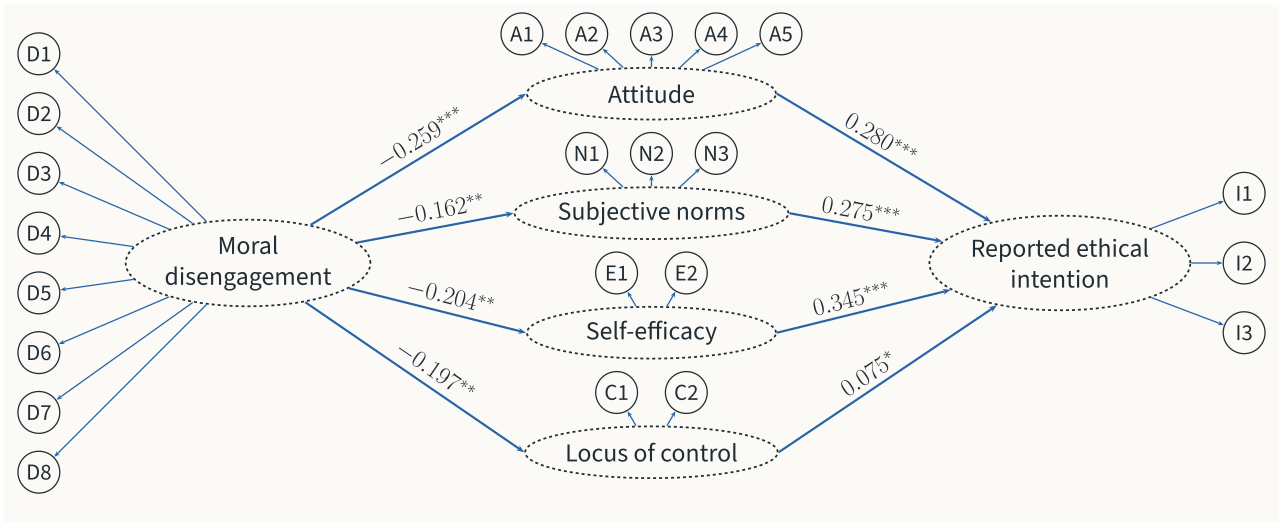
Travel-expenses model with measurement indicators. Dashed latent constructs point to solid observed indicators: moral disengagement to D1–D8, attitude to A1–A5, subjective norms to N1–N3, self-efficacy to E1–E2, locus of control to C1–C2, and reported ethical intention to I1–I3. Moral disengagement points to attitude (−0.259), subjective norms (−0.162), self-efficacy (−0.204) and locus of control (−0.197); their paths to reported ethical intention are 0.280, 0.275, 0.345 and 0.075 respectively. Blue arrows denote directed paths. Item responses are aligned to the fitted constructs by recoding. Measurement loadings, additional predictors and disturbances are omitted.

Dashed: latent constructs · Solid: questionnaire indicators · Blue: directed paths · * p < 0.10, ** p < 0.05, *** p < 0.001.

Black, Burton and Cieslewicz (2022), Improving Ethics…, Figure 6, p. 965; Table 2, p. 962; indicators from Table 4, p. 975. PLS path modelling.