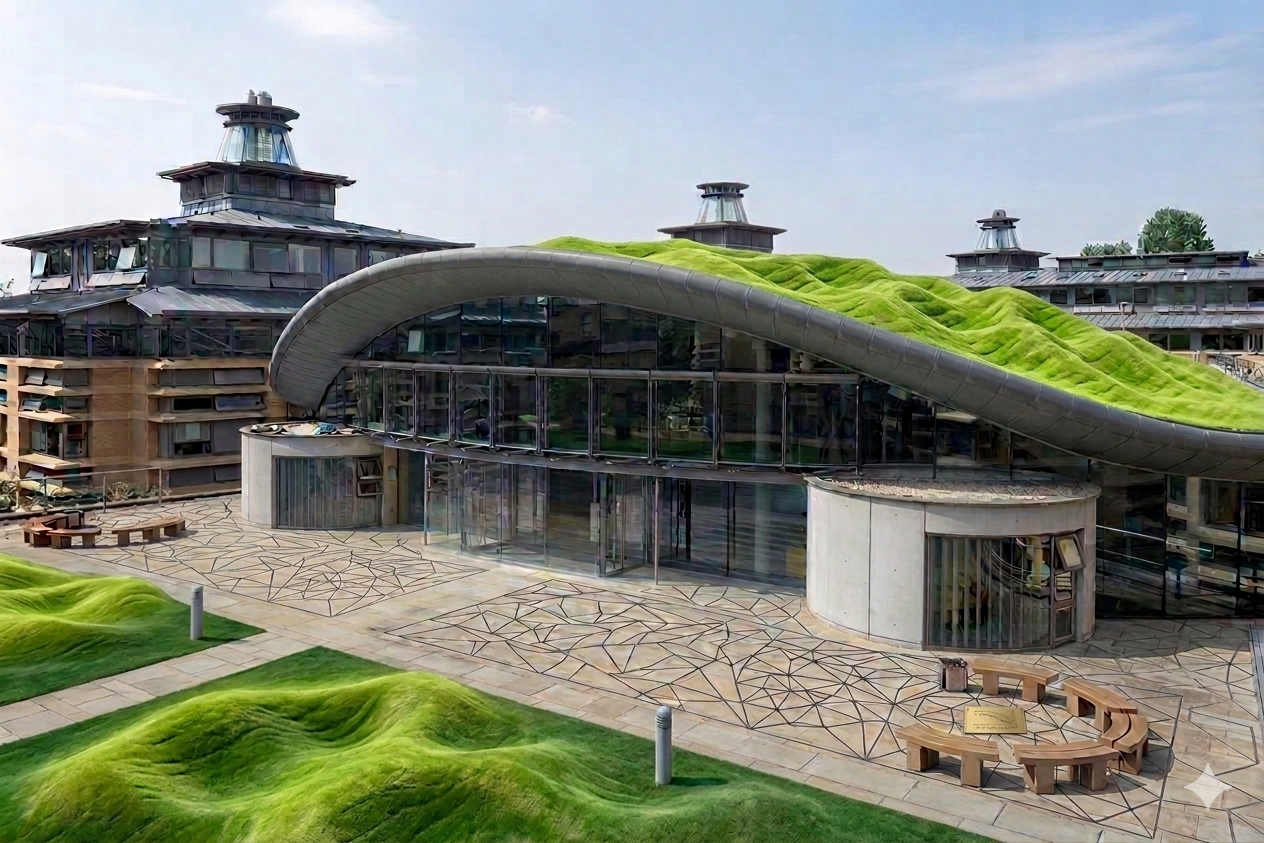
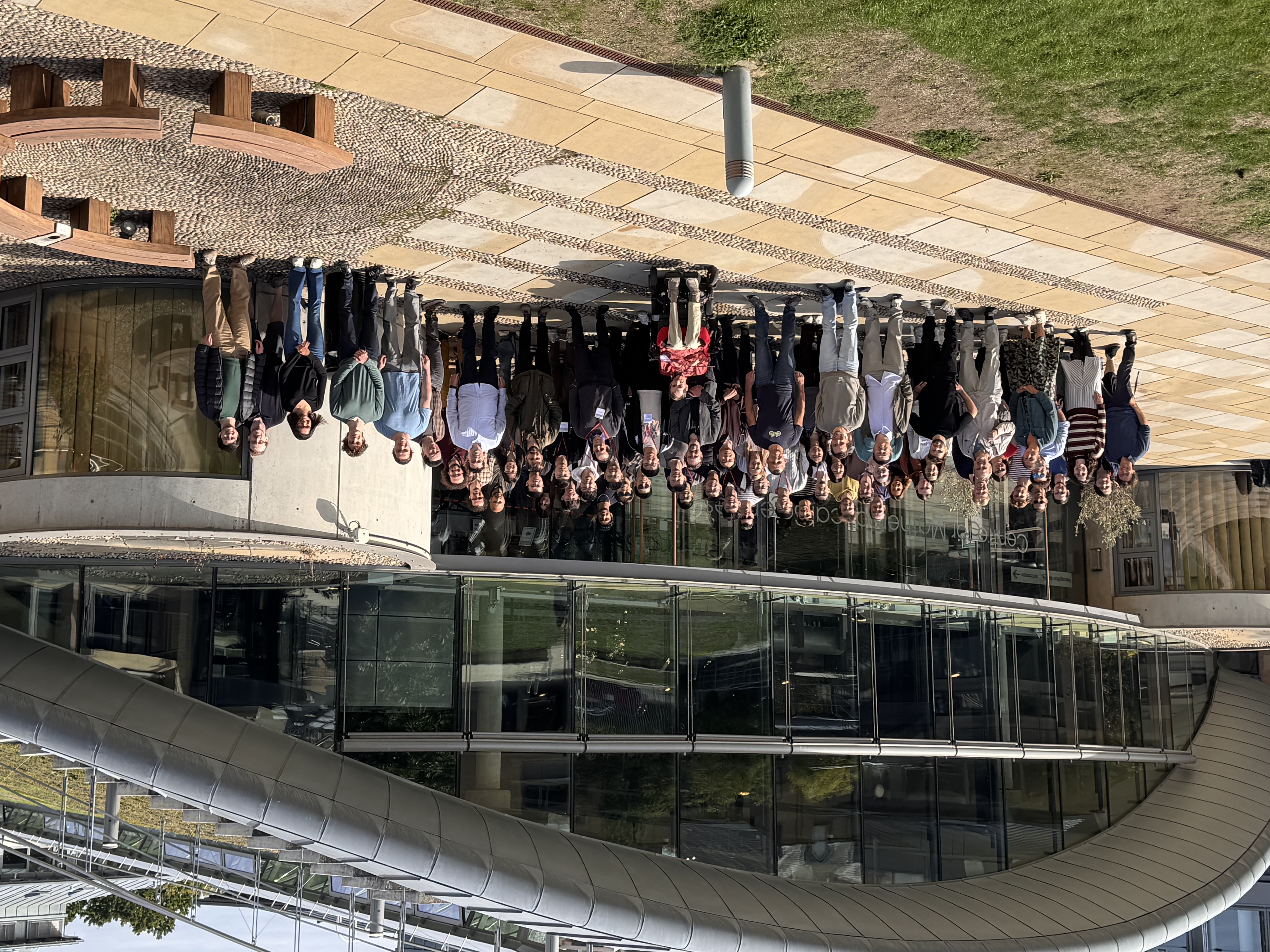
The conference will focus on recent developments in probability theory. It will take place at the Centre for Mathematical Sciences.
Mini-Courses
- Marek
Biskup (UCLA)
A renormalization-based approach to the hierarchical integer-valued Gaussian free field
The integer-valued Gaussian free field can be thought of as the continuum-valued Gaussian free field conditioned on taking values in integer multiples of the root-of-the-inverse-temperature. For the setting where the continuum field exhibits logarithmic correlations, the conditioning leads to a BKT-phase transition: the discrete-valued field remains rough, continuum-valued like, at high temperatures but is smooth, with toned-down correlations, at low temperatures. I will describe a renormalization-group based approach to this transition in the context of the hierarchical model (which is a priori log correlated) where this approach is relatively easy to implement. While particular instances of such analysis are classical, dating back to mid 1980s, recent innovations (obtained jointly with Haiyu Huang) permit seamless extension all the way up to, including and even going somewhat beyond the critical point. - Grégory
Miermont (ENS de Lyon)
Scaling limits of random maps with large faces
Random maps, which are simply random gluings of Euclidean polygons, provide natural models of discrete random surfaces that are expected to converge to universal continuum models of 2-dimensional random geometry, given in particular by Liouville quantum gravity surfaces. This is particularly well-understood in the context of "Brownian geometry" —a.k.a. LQG(\(\sqrt{8/3}\)) surfaces— which corresponds to limits of random maps with tame face degrees and in which the gluing is uniformly chosen among all possibilities. In this mini-course, we will study the situation where the gluing is still uniformly random, but where the faces are allowed to obey power-law degree distributions, leading in the scaling limit to random Sierpinski carpet or gasket-like objects. In the spirit of Pitman's "combinatorial stochastic processes", we will give a description of these limiting spaces in terms of classical objects of probability theory, namely, Lévy processes, and Poisson random measures, and discuss its relationship with conformal loop ensembles. This is based on joint work with Nicolas Curien and Armand Riera.
Program
Monday, 21 September
| Time | Event |
|---|---|
| 09:00 – 09:15 | Registration |
| 09:15 – 10:15 |
Marek Biskup (UCLA)
A renormalization-based approach to the hierarchical integer-valued Gaussian free field (Lecture 1)
|
| 10:15 – 10:45 | ☕ Coffee break |
| 10:45 – 11:45 |
Grégory Miermont (ENS de Lyon)
Scaling limits of random maps with large faces (Lecture 1)
|
| 12:00 – 13:30 | 🍽️ Lunch Fitzwilliam College |
| 14:00 – 14:50 |
Elie Aïdekon (Fudan University)
On the Hausdorff dimension of the BBK points of infinite multiplicity
|
| 15:00 – 15:50 |
Christian Webb (University of Helsinki)
A first taste of bosonization
|
| 16:00 – 16:30 | ☕ Tea break |
| 16:30 – 17:20 |
Xin Sun (Peking University)
CFT Perspectives on 2D Percolation
|
17:30 – 18:30: Reception
Tuesday, 22 September
| Time | Event |
|---|---|
| 09:15 – 10:15 |
Grégory Miermont (ENS de Lyon)
Scaling limits of random maps with large faces (Lecture 2)
|
| 10:15 – 10:45 | ☕ Coffee break |
| 10:45 – 11:45 |
Marek Biskup (UCLA)
A renormalization-based approach to the hierarchical integer-valued Gaussian free field (Lecture 2)
|
| 12:00 – 13:30 | 🍽️ Lunch Fitzwilliam College |
| 14:00 – 14:50 |
Alexis Prévost (University of Bonn)
Hausdorff dimension of the critical clusters for the metric graph Gaussian free field
|
| 15:00 – 15:50 |
Catherine Wolfram (Yale University)
The multinomial dimer model
|
16:00 – 18:30: Poster session with tea
Wednesday, 23 September
| Time | Event |
|---|---|
| 09:00 – 09:50 |
Malin Palö Forsström (Chalmers University of Technology)
The toric code and lattice gauge theories
|
| 09:50 – 10:40 |
Jacopo Borga (MIT)
Tightness for longest directed distances on weighted bipolar-oriented planar maps
|
| 10:40 – 11:10 | ☕ Coffee break |
| 11:10 – 12:00 |
Steffen Rohde (University of Washington)
Mating of trees from the analytic perspective
|
| from 12:00 | Free afternoon (no lunch provided) |
from 18:45: Reception & dinner Magdalene College
Thursday, 24 September
| Time | Event |
|---|---|
| 09:15 – 10:15 |
Grégory Miermont (ENS de Lyon)
Scaling limits of random maps with large faces (Lecture 3)
|
| 10:15 – 10:45 | ☕ Coffee break |
| 10:45 – 11:45 |
Marek Biskup (UCLA)
A renormalization-based approach to the hierarchical integer-valued Gaussian free field (Lecture 3)
|
| 12:00 – 13:30 | 🍽️ Lunch Fitzwilliam College |
| 14:00 – 14:50 |
Eleanor Archer (Université Paris-Dauphine)
Local limits of uniform spanning trees and forests
|
| 15:00 – 15:50 |
Hugo Vanneuville (Université Grenoble Alpes)
Covariance formulas in percolation
|
from 16:00: Discussions with tea
Friday, 25 September
| Time | Event |
|---|---|
| 09:00 – 09:50 |
Ron Peled (University of Maryland)
Non-crossing random surfaces and sloped height functions
|
| 09:50 – 10:40 |
Grégory Miermont (ENS de Lyon)
Scaling limits of random maps with large faces (Lecture 4)
|
| 10:40 – 11:10 | ☕ Coffee break |
| 11:10 – 12:00 |
Marek Biskup (UCLA)
A renormalization-based approach to the hierarchical integer-valued Gaussian free field (Lecture 4)
|
| 12:00 – 13:30 | 🍽️ Lunch and departure Fitzwilliam College |
Organizers Jason Miller, Pierre-François Rodriguez, and Wendelin Werner
Contact camprobconf2026@gmail.com
Supported by